
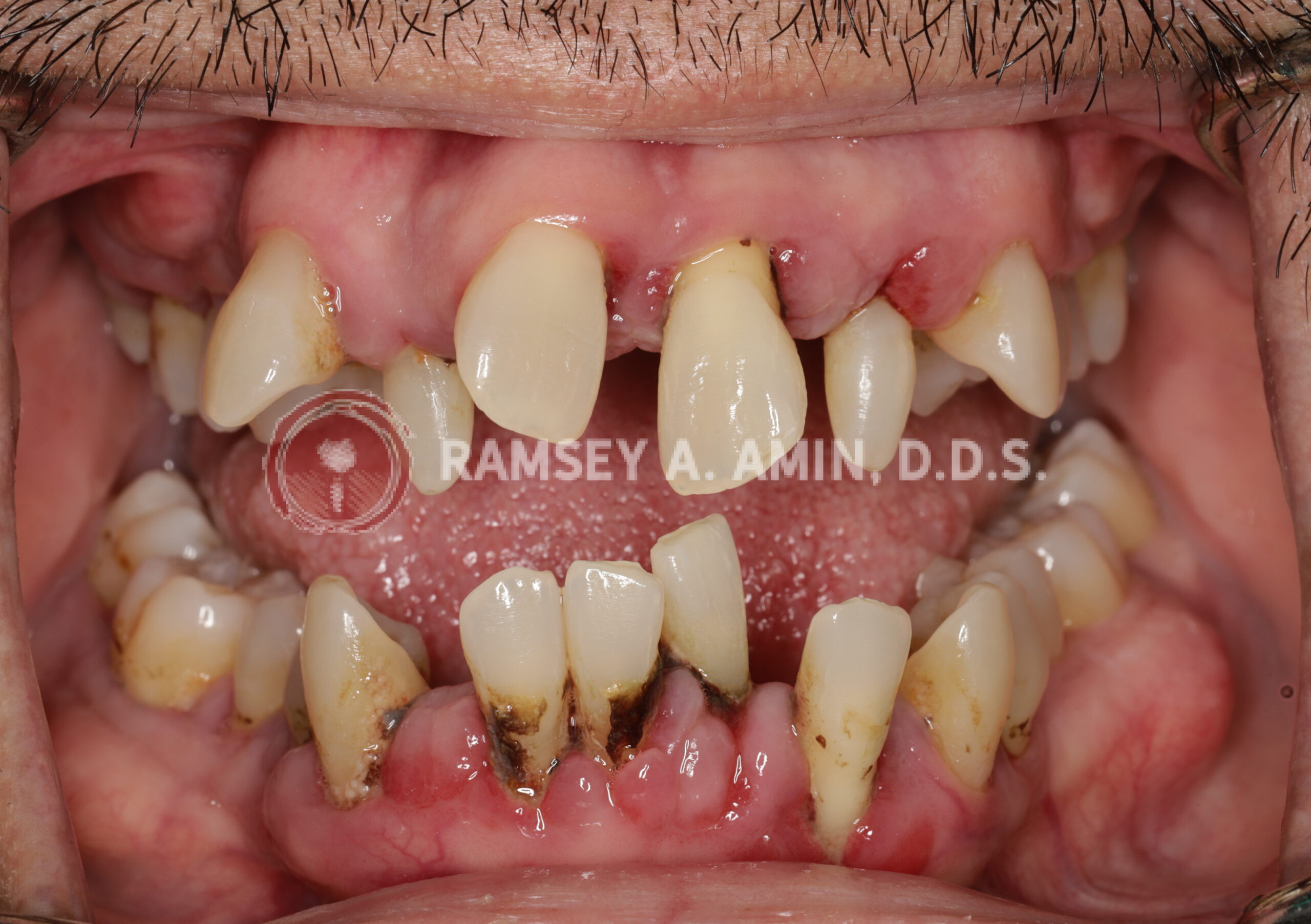
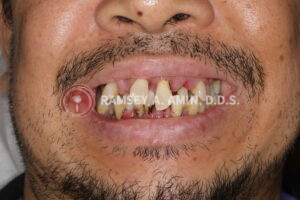
Let me tell you about “John”, a 45-year-old patient of Filipino descent who came to me with a story that’ll stick with me forever. By the time he walked into my office, his teeth were loose, severely crooked, and ravaged by advanced periodontal disease. He was on blood thinners and wanted full mouth dental implants to fix his smile.
To make matters more complex, he’d survived a heart attack at just 30 and was now on Eliquis®, a blood thinner critical for preventing life-threatening clots. His smile had become a source of embarrassment, and he was ready to reclaim his confidence — safely.


Why This Case Wasn’t Just About “Teeth”
John’s situation wasn’t a simple “one-tooth” fix. Full-arch dental implants for patients on blood thinners like Eliquis®, Xarelto®, Pradaxa®, or Warfarin require meticulous planning. Stopping these medications even briefly raises the risk of clots, which can lead to strokes or heart attacks.
Note: These medications are often NOT stopped for simple implants or extractions. They almost always have to be stopped for full mouth (all-on4/6) cases.
Unfortunately, another office had rushed to extract all his teeth without proper medical coordination. That’s a hard no in my book.
Here’s what I did for this case:
- Medical consultation with his cardiologist
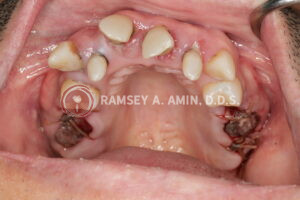
- Staged Extractions: We started by removing only his back teeth. This let us test how his body handled bleeding and healing before committing to the full surgery.
- Collaboration With the Cardiologist: We paused Eliquis® for 48 hours pre-surgery (and resumed it 48 hours post-op), monitored his heart closely during IV sedation, and used leg compression pumps to keep blood flowing.
- Bleeding Management: Tools like electrocautery and microfibrillar collagen helped control bleeding during surgery. I also used L-PRF (leukocyte platelet-rich fibrin)—a natural healing booster made from his own blood (learn more about PRF here).

Here’s how I minimized risks:
- “Stay Moving” Rule: I advised John to wear long compression socks and to keep walking during his short time off Eliquis® to reduce clot risks.
- Emergency Access: He had my personal emergency number post-surgery. No one should feel alone during recovery.
- Timing Matters: Surgeries like this should never happen right before weekends or holidays. We scheduled his procedures when our team was fully available to handle any surprises.
Designing a Smile That Felt Like Him
John’s teeth weren’t just damaged; they were very crooked. But here’s the interesting part: he didn’t want a Hollywood-perfect smile.
“I want to look like me,” he said.
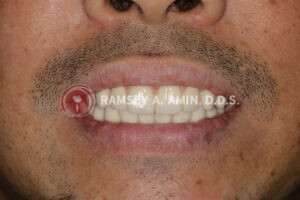
So, I used digital smile design to create prototypes that kept subtle imperfections. The result? A natural, masculine smile that looked “straight enough” from the front, but preserved his unique character.


After placing his temporary implant healing teeth prototypes, John nailed his oral hygiene routine. This is non-negotiable before moving to final restorations. For patients with severe periodontal disease, hygiene habits can make or break implant success (read more about implants after gum disease here).
Key Takeaways for Patients on (anticoagulants) Blood Thinners


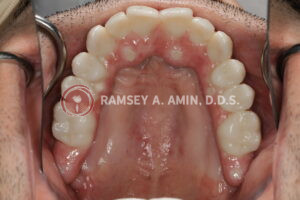


If you’re on medications like Eliquis and need major dental work:
- Ask About Staging: Rushing into extractions or implants can be dangerous.
- Medical Coordination: Your dentist should consult your cardiologist and/or primary care doctor.
- Plan for Safety: Compression socks, movement, and leg pumps aren’t just extras — they are lifelines.
John’s case wasn’t easy. However, it’s proof that even the most complex dental challenges can be overcome. This requires careful planning and a team that prioritizes safety. This is especially true in the case of blood thinners and full mouth dental implants, as you can see in this case.
If you’re navigating similar issues—whether it’s blood thinners, gum disease, or simply wanting a smile that feels authentically yours — reach out to me.
You are worth it!
And for your reference, here’s a simple chart that lists popular blood thinners, along with the generic name and type of blood thinner:
| Rank | Generic Name | Brand Name(s) | Type |
|---|---|---|---|
| 1 | Apixaban | Eliquis® | DOAC (oral) |
| 2 | Rivaroxaban | Xarelto® | DOAC (oral) |
| 3 | Warfarin | Coumadin®, Jantoven® | Vitamin K antagonist |
| 4 | Dabigatran | Pradaxa® | DOAC (oral) |
| 5 | Edoxaban | Savaysa® | DOAC (oral) |
| 6 | Enoxaparin | Lovenox® | Low-molecular-weight heparin (injectable) |
| 7 | Heparin | Various (Heparin Sodium) | Unfractionated heparin (injectable) |
| 8 | Fondaparinux | Arixtra™ | Factor Xa inhibitor (injectable) |
| 9 | Aspirin | Bayer®, Ecotrin®, etc. | Antiplatelet |
| 10 | Clopidogrel | Plavix® | Antiplatelet |
Thank you for this very informative article. I appreciate how you clearly explained the challenges and considerations for patients on blood thinners undergoing full mouth implant treatment. It really highlights the importance of careful case planning and coordination with medical history.
I have all on 4’s implants. One tooth in the back was forces with screw too tight. I’ve been in pain 6 months. I went back at least 3 times due to pain. Still same results. What should I do?
Remove the bridge and inspect under it.
Hello Dr. Amin,
I had my full mouth All on 4 surgery in December 2022. They decided to add an extra implant front and center of my lower jaw. Since, it’s been a slow uphill battle. I found it odd that an extra implant was added, but not used with a screw. They did place an abutment and use it without a hole. The multiuse abutemets are shaped like little oval Legos by Tru Abutment. I believe they’re called AOT Plus short abutment.
The entire time I was wearing the temporary arches, the back upper implant was not tight and it felt like it giving when bite pressure was applied to the area.
I finally received the permanent zirconia. It felt gritty when Lighly grinding my teeth. Approximately 3 months later, While eating shrimp pasta, I heard a snap and felt the same slipping sensation. I was later able to feel a crack near the implant on the left upper side.
I’m about to return for the replacement bridge. My Dentist said the plan is to not screw in the upper left front implant. I am concerned about this decision, not to screw in all implants, which I thought provided even distribution.
I would appreciate any feedback you may have.
Thank you in advance!
Lori
Hi Lori – Of course I have not examined you but I would agree that all screws should be engaged. Maybe it is cemented and not screwed as a combination type of prosthesis? How is it going now?
This article may shed some light for you: https://burbankdentalimplants.com/what-are-multi-unit-abutments-for-dental-implants-insight-by-ramsey-amin-dds/