
I want to walk you through a specific patient case to clear up some confusion about dental implant treatment planning. Some wonder if all teeth need to be removed. Others often ask what guides the decision to remove teeth and place implants. This case highlights a tailored, patient-focused approach.
Patient Case: 70-Year-Old, Missing Molars and Loose Teeth
This patient is about 70 years old and has lost all his molars as well as some front teeth. In such cases, there are multiple treatment options. Sometimes, you can keep good teeth and implant around them, especially if you have more healthy than unhealthy teeth. It’s often best to save what you have and rebuild what is missing.
Below is a summary of the video. It is best to watch the video as it has so much detail to learn from
Individualized Treatment Planning
In this particular case, the lower jaw still has good teeth; therefore, we will place implants only in the back where teeth are missing. When the upper jaw has few or no good teeth remaining and the teeth are loose or not viable, the best plan is usually to remove all the upper teeth and replace them with implants.
Importantly, a full arch replacement on one jaw does not mean you need it for the other jaw. You can have a combination of teeth and implants on one arch and full implants on the other. Treatment should always be customized for each patient.
Avoid “dental implant super centers” or “mills” that remove all teeth indiscriminately; it’s irresponsible and unethical.
Full mouth removal (removing all teeth) should almost never be done for younger patients under 30 unless absolutely necessary.
Smile and Bite Evaluation
This patient’s smile was not aesthetic, and while some teeth were healthy, their position was not ideal. At age 70, orthodontics was not a practical option. The lower teeth were crooked but didn’t bother the patient. Our plan: replace the full upper jaw and keep the lower teeth, cleaning them up and adding implants where needed.
We used a temporary restoration for the upper jaw—a plastic Essix bridge. Evaluating the bite and vertical dimension is critical. Factors like lip support are important, especially in female patients. For the lower jaw, cleaning is planned, and implants will restore back teeth where bone loss has occurred.
Bone Grafting and One-Visit Complete Care
Significant bone loss was present, especially in the back. This will be addressed with bone grafting for the lower jaw. For this patient, all surgical work—teeth removal, implant placement, and bone grafting—was done in one visit under sedation.
Some of the roots removed from the upper jaw were ground up. They were used as graft material. This was combined with bone from other sources. This “recycling” approach supports rapid and successful rebuilding.
Surgical Procedure Summary
- Full upper arch teeth removal and implant placement
- Bone grafting using the patient’s own roots, supplemented with cadaver bone
- Placement of two implants on each side of the lower jaw
- Cleanup and retention of healthy lower anterior teeth
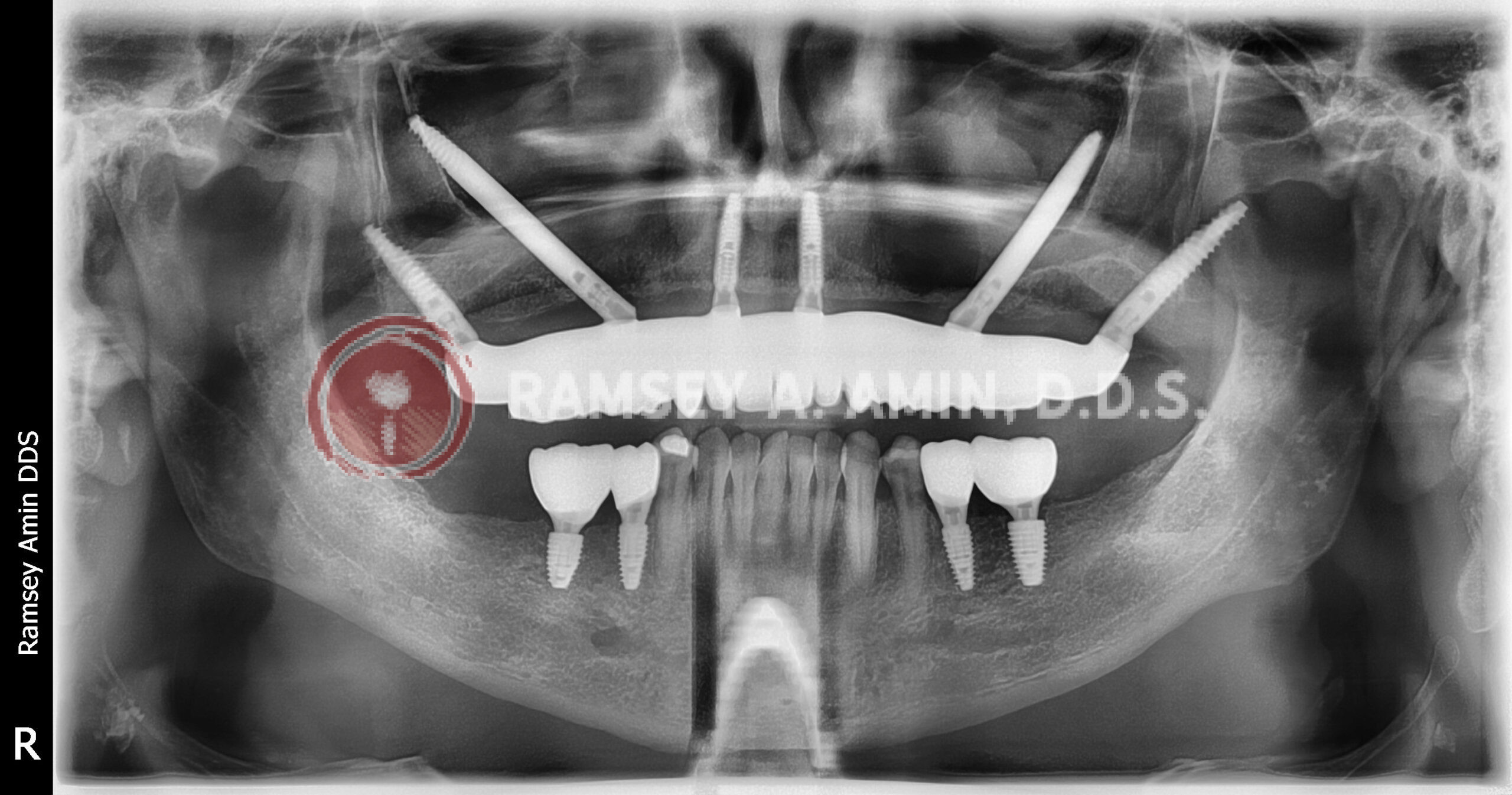
During surgery, four lower implants were placed, and bone grafts restored lost bone. The upper jaw received zygomatic and pterygoid implants—advanced implants anchored in the cheekbone when regular bone is insufficient.
Immediate Teeth and Advanced Techniques
The day after surgery, the patient received temporary teeth for the upper jaw. The lower jaw was left to heal for three to four months before final restorations. We use polymethylacrylate (milled PMMA) for temporaries. Milled prosthetics are stronger and more durable than printed teeth, resembling the final result to help the patient preview their outcome.
Restoration Types: FP1 vs FP3
Patients may need pink “gums” added for durability or lip support. This case required some pink acrylic for functional and esthetic reasons, explained in detail in numerous articles on our blog.
Healing progressed well, and the final restoration for the upper arch was a full zirconia bridge with 14 teeth, supported by six evenly distributed implants, including challenging pterygoid implants in the very back. This configuration provides the highest stability; not all patients are candidates for extra posterior implants due to bone limitations.
The lower arch retained individual teeth, with gold- or titanium-anodized custom abutments supporting new molars through implants.
Lab Work and Maintenance
High-end lab work ensures tight connections, highly polished zirconia, and no food traps. Everything is convex for easy cleaning. Patients are taught how to use Waterpik and floss threaders to maintain hygiene. There’s a strong emphasis on maintenance—regular visits, X-rays, cleanings, and gum evaluations—to protect long-term results.
Final Results
Patients receive natural-looking teeth without an overdone, ultra-white appearance unless requested. The final X-rays confirm bone limitations and the strategic placement of specialized implants.
Individual implant-supported teeth on the lower arch allow for proper flossing. All parts fit seamlessly, thanks to advanced digital scanning—no traditional impressions required.
Key Points for Patients
- You do not need to remove all teeth for implant therapy. Treatment should be personalized.
- Full arch replacement on one jaw does not mean both jaws require it.
- Advanced techniques allow immediate teeth placement, even when bone is very limited.
- Quality lab work and ongoing maintenance are essential for successful, long-lasting results.
- Always choose a dental implant specialist dedicated to excellence and customization—not a one-size-fits-all approach.
Dental implants are not permanent, but with proper care and the right technique, they can last many years. Read our dedicated blog post on implant longevity for further information.